Academic Papers on Generative AI
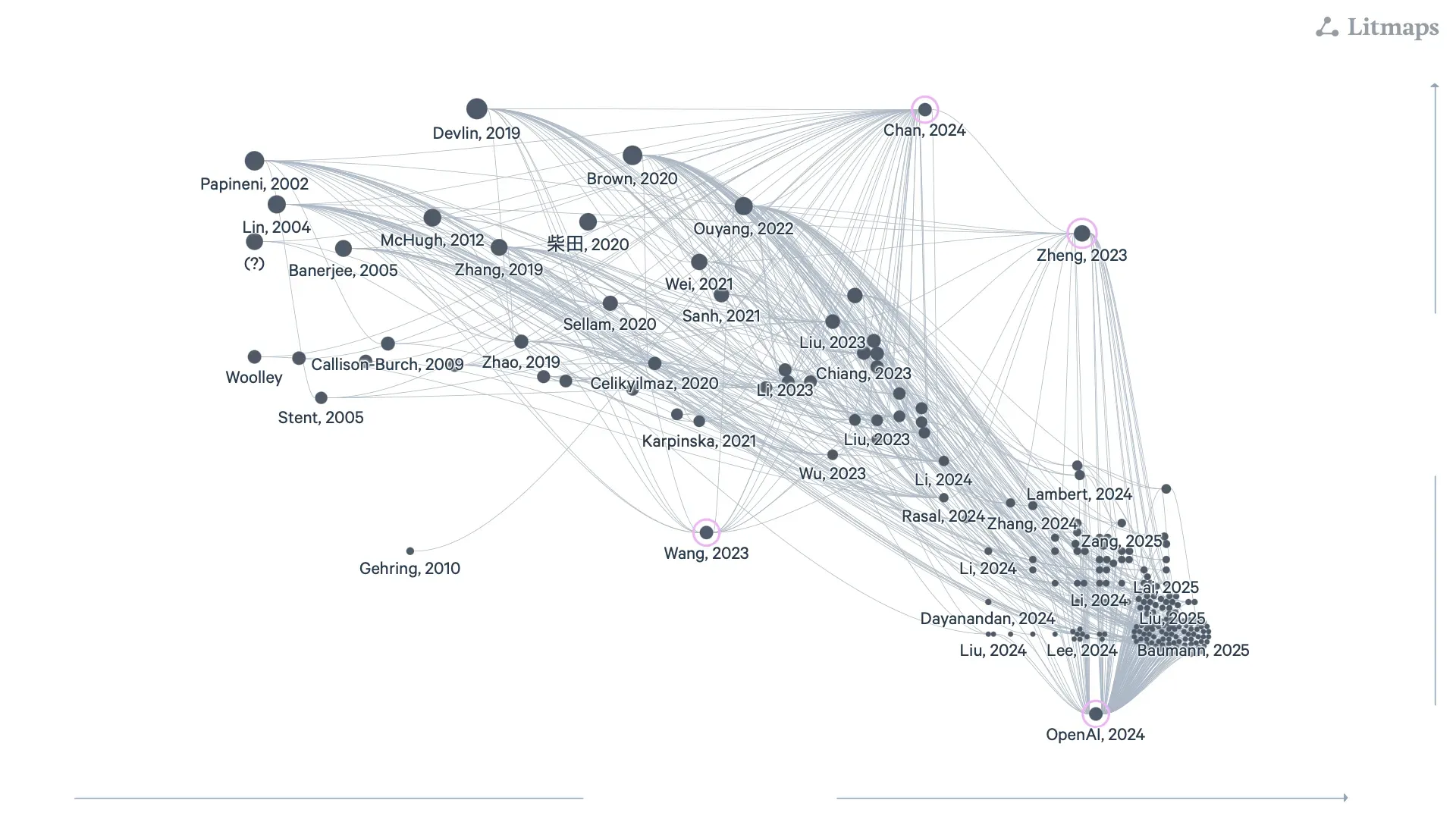
Litmaps is a platform that allows you to search a catalog of more than 270 million articles using citation and reference connections to find the most relevant works.
It also offers advanced filters (publication date, author, journal, H-index, and SJR quartiles) that help you refine your search with precision. With its new semantic search, Litmaps identifies articles based on content similarity in abstracts—ideal for emerging topics like Generative AI—using artificial intelligence to capture conceptual nuances.
Collection Management in Litmaps
You can create collections by dragging and labeling articles with custom tags, facilitating the organization of subtopics like “Diffusion Models” or “Text-to-Image Applications.”
With Litmaps Pro, receive weekly alerts (Monitor) so you don’t miss new publications in your Generative AI area, based on your existing Litmaps. Additionally, the Zotero integration automatically synchronizes your collections, avoiding manual import tasks and keeping your library always up to date.
Sharing and Collaborating
Set up a collaborative workspace in Litmaps Teams to share maps and collections with your lab or Generative AI research team, like a Google Docs for academic literature.
Generate public links or integrate your Litmaps into your blog or presentation, allowing colleagues and reviewers to visualize your research structure without an account.
Example for Generative AI
- Architecture Exploration: start your Litmap with one (or several) seed papers, for example on GANs or VAEs, and iteratively expand to cover recent variations and multimodal applications or agents.
- Detecting Research Gaps: use date and semantic filters to identify underexplored areas, such as advanced prompts in Diffusion Models.
- Continuous Review: activate Monitor to receive every new article on “LLMs in code generation” directly in your Litmap, ensuring an always up-to-date literature review.
Conclusion
Litmaps provides a comprehensive solution for searching, managing, and sharing collections of academic articles, enhancing everything from initial exploration to team collaboration. I leave you an example on Generative AI and Agents.