Competitive AI Timeline 2025-2026: models, coding agents, and platforms
A web-native, bilingual version of the 2025-2026 competitive AI chronology, with an interactive timeline, vendor matrix, and executive summary.
Restless engineer, focused on Generative AI, technology and passionate about trekking and the Camino de Santiago.
A visual essay on how value creation changes once coding stops being the bottleneck and leverage shifts to orchestration.
Read the book →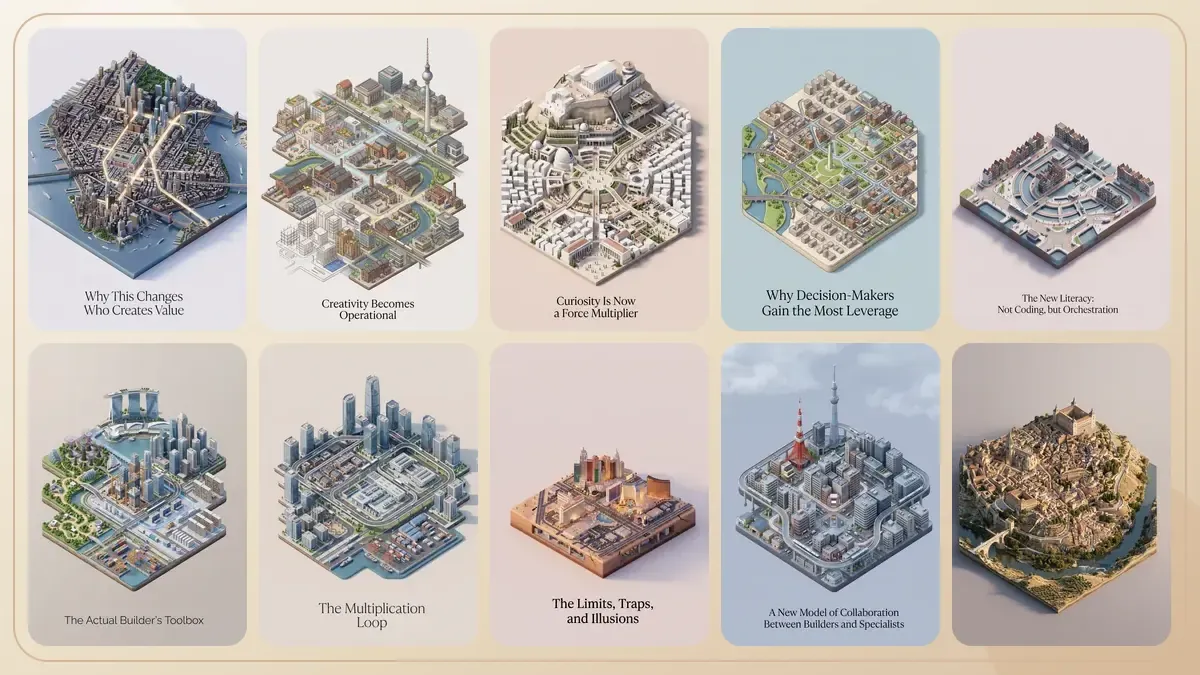
A web-native, bilingual version of the 2025-2026 competitive AI chronology, with an interactive timeline, vendor matrix, and executive summary.
A practical, low-cost playbook to run Docker apps behind Traefik and Cloudflare on one Hetzner VPS with repeatable security checks.
As the AI industry confronts the 'energy wall' of traditional digital architectures, analog computing has emerged as the critical solution for sustainable scaling. This report analyzes the technical and commercial milestones of 2025-2026, highlighting how novel charge-domain and resistive memory architectures allow computation to occur directly within memory. We examine pivotal breakthroughs, including Peking University's solution to the analog precision bottleneck and Blumind's microwatt-level sensor processing. By eliminating data movement, these analog AI chips are now validating real-world efficiency gains of 100x compared to standard GPUs, unlocking new possibilities for edge intelligence in defense, automotive, and mobile sectors.